The ASICS GEL-Slowcush is All About Running Slow and Feeling Good About It
The ASICS GEL-Slowcush is a shoe that runs smooth and comfortably at slower paces.

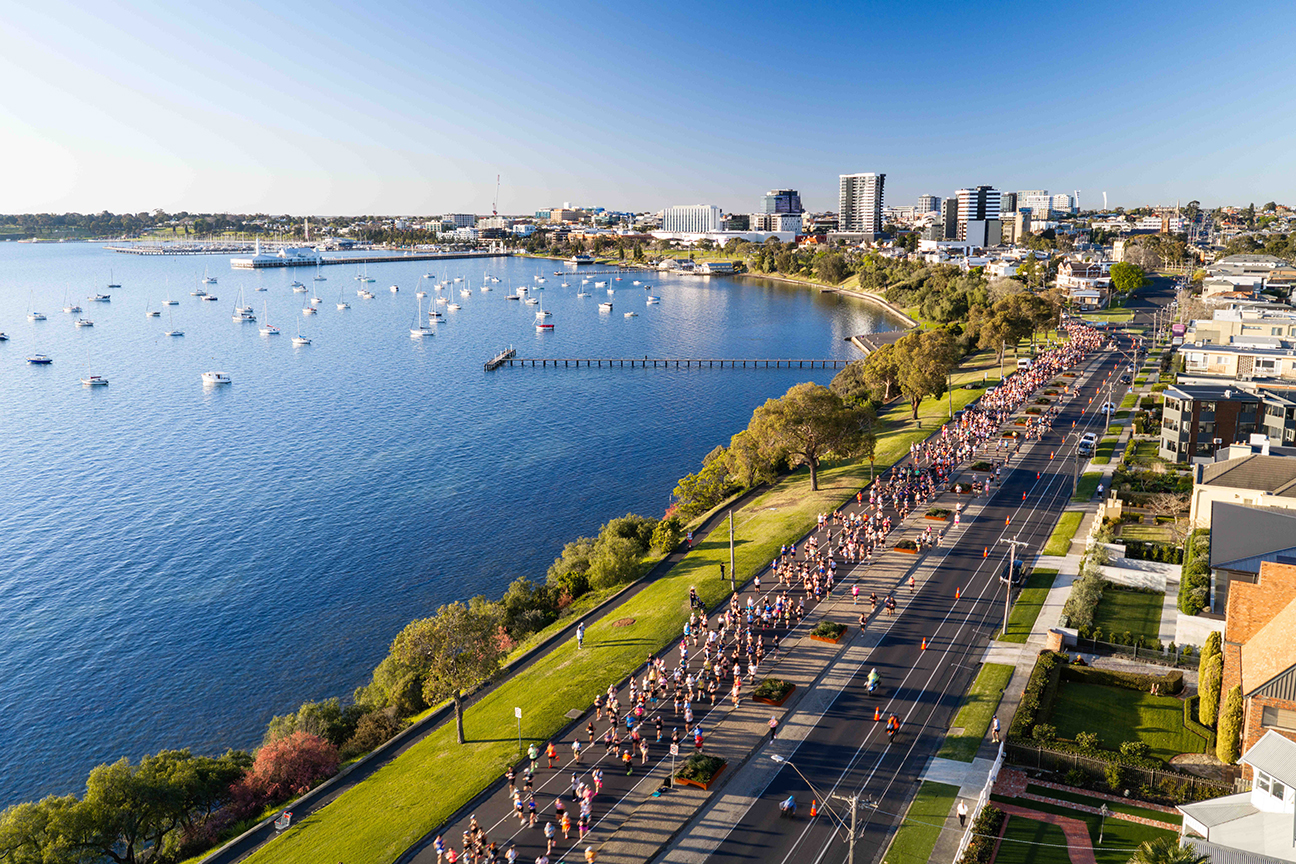
The Geelong Running Festival was full of the community vibes for locals and long-traveling tourists alike.
I’ve been fortunate run races all over the world through the years, but I don’t think I’ve ever traveled quite this far for one that clocked in at just 4 miles. Recently, I boarded a flight in Colorado, laid over in San Francisco, crossed the length of the Pacific on a 16-hour flight, and landed in Australia for the sole purpose of running a 6.5K community race in a city I’d never before set foot in.
It was a wild adventure, and I’d do it again in a heartbeat. More than 6,000 runners took part in the inaugural Geelong Running Festival, which included six events over the weekend of September 19–20. But for me, it was one of the most authentic running experiences I’ve had in a long time. Or as they say Down Under, it was fair dinkum.
But to understand why I did it, you have to know Lee Troop.
Troopy, as everyone knows him, is a three-time Australian Olympic marathoner who grew up in Geelong and spent most of his elite running career there before moving to Boulder, Colorado, in 2009 to train with elite athletes during his final years of competing. He stuck around, built a second life coaching athletes, operating a running shop, putting on races and giving back to the community. Boulder is one of the world’s running meccas and the place I’ve worked as a sports journalist since the mid-1990s. I met Troopy not long after he landed in town, got to know him through reporting on his athletes, and, of course, talking about running over a few beers.
What I appreciated about Troopy then, and still do, is that he’s someone who honed his talent by channeling blue-collar roots, doing the work relentlessly, and owning it without excuses. He’s also always been a firebrand—blunt, direct, not out to stir the pot but not suffering fools gladly either. That fierceness is what made him a great runner, and it’s the same recipe he carried into everything else he’s done. Jake Riley is the bright shining example: he revived his career under Troopy’s guidance and finished second at the 2020 U.S. Olympic Trials Marathon, earning a trip to run the marathon for the U.S. in the Tokyo Olympics.
In Boulder, Troopy rebuilt the Pearl Street Mile, developed trail races in the foothills, brought the city its first downtown Thanksgiving turkey trot, created running programs for kids that honored some of Boulder’s legendary runners, and built the weekday night fun runs at Avery Brewing Company from a few dozen regulars into a weekly gathering of 200 to 300 runners. He also once quietly trained a young man with special needs on his way to finishing his first running races.
Troopy did a lot for Boulder’s running community, certainly more than most. But he is first and foremost a product of Geelong. He laced up his shoes for the first time at 11, joining his father, Joe, on training runs through the suburb of Whittington as part of a simple family fitness push.
That backyard beginning turned into a real career under the guidance of fellow Aussie great Steve Moneghetti. He raced the Commonwealth Games, represented Australia at two world championships, broke Ron Clarke’s 33-year-old Australian 5,000-meter record in 1999, and eventually competed at three Olympic Games—Sydney 2000, Athens 2004, Beijing 2008.
Few runners carry a hometown’s name into that many Olympic start lines. Fewer still come home looking for a way to give something back to the streets that raised them.
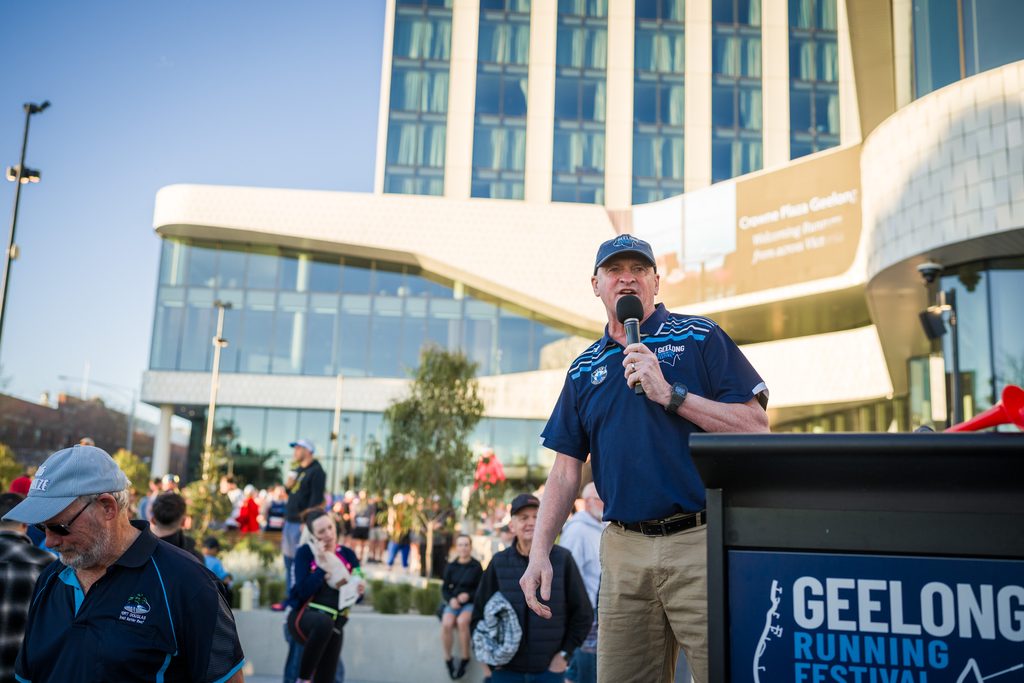
That’s exactly what the Geelong Running Festival represented. Geelong has never lacked sporting pride—it’s a city that lives and dies with footy, aka Aussie rules football, and specifically their Geelong Cats. But for all that passion, it never had a marathon of its own. No signature 26.2-mile event stamped with the city’s name. It took Troopy nearly eight years to change that: starting and stopping his initial attempt in 2018, then building support, designing a course that could actually show the city off, and ultimately convincing his own community that a marathon wasn’t just possible, but long overdue.
So when it finally happened, I wasn’t going to watch from afar. I cashed in my airline points and got on a plane.
In the days before the race, I shadowed Troopy through final preparations, and he was in classic form. For his Boulder races, he pretty much did everything to organize them, and although he had assembled a small support team in Geelong, he was still involved in every detail. As a result, his phone rang constantly. He bounced across town, chased down FedEx boxes of finisher medals, led the last training-club sessions, pumped the race in local media, and worked with local officials on everything from the expo setup to the post-race recovery zone.
And even though his name and legacy carried the event, it wasn’t about him at all. Ultimately, he worked relentlessly to put the final touches on something he was building for the community he had been immersed in his entire life. It all came to life in a vibrant pre-race dinner inside GMHBA Stadium with dozens of those who bought into his vision—local and state officials, key sponsors, his family, and Moneghetti himself.
So how did the inaugural Geelong Running Festival go? Wow, it was a banger day, and Geelong showed up in a big way. The action kicked off Saturday with the Kids and All Abilities Run, started by triple Olympian Nathan Deakes, who also stuck around to hand out medals to every single finisher—fittingly, nearly 20 years after breaking the 50K walk world record on that very same Geelong waterfront. Sunday morning, at 7 a.m., the marathon, half marathon and 6.5K went off in succession, and the city turned out in force.
All three races shared stretches of the same course, which gave the whole event a fuller, bigger feel, like you were part of something larger than your own distance, and it meant spectators could post up in one spot and cheer wave after wave of runners across every race instead of just their own.
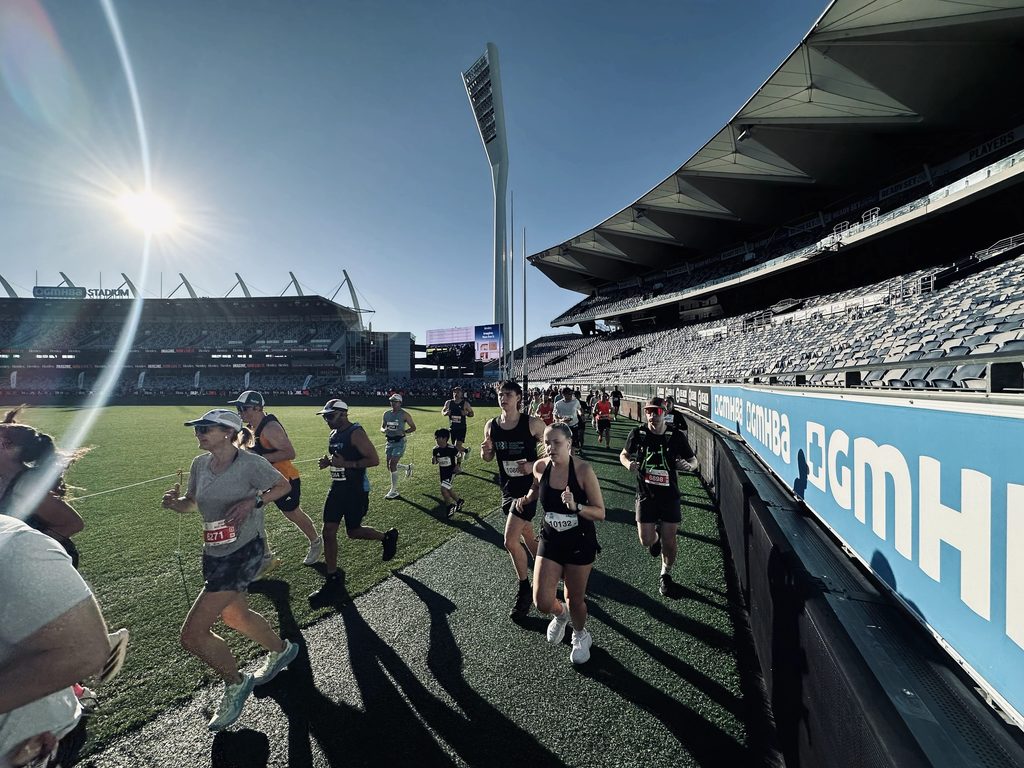
Two awe-inspiring moments I won’t forget: The first was coming off the street and suddenly finding myself inside GMHBA Stadium—video cameras fixed on runners and broadcast on the stadium’s big video board. I wasn’t the only one who felt it. Half-marathon winner Brooke Williams, a Geelong local and self-described Cats fanatic, called that stretch the highlight of her race too. “It’s really special to me,” she said afterward. The second was the grand descent down Moorabool Street with Corio Bay opening up in the distance, an epic view that made many of us forget how tired our legs were.
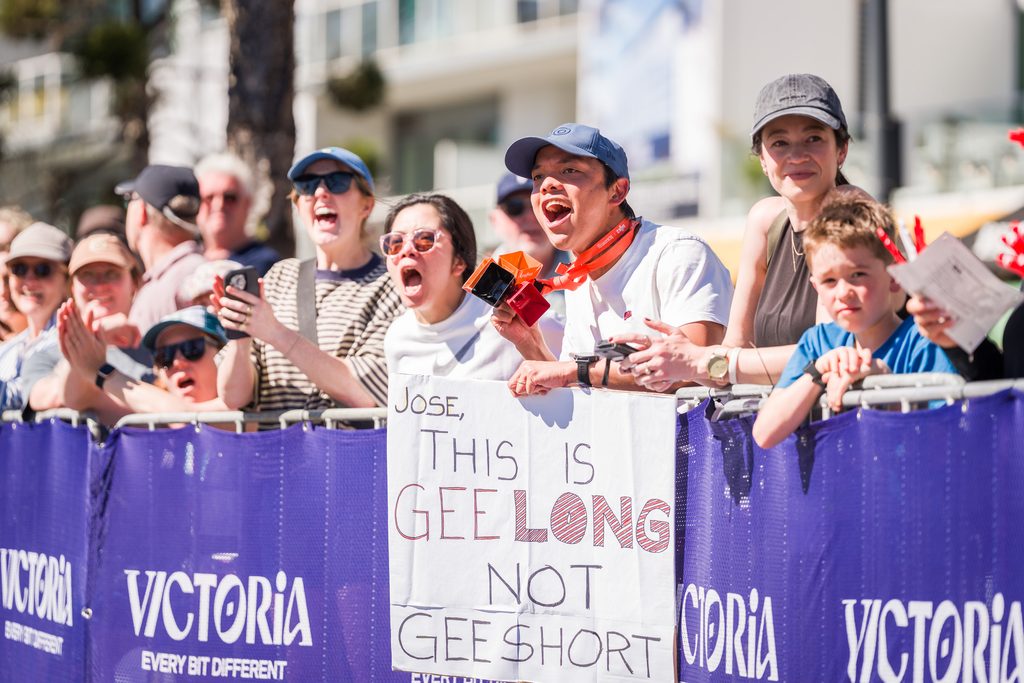
Then there was the finish itself: Brougham Street, packed shoulder to shoulder, runners funneling in from three distances into the same chute near Steampacket Gardens, spectators stacked deep and cheering everyone home regardless of pace.
Up front, local runner Sarah James won the women’s marathon in 2:51:55, and Colm Fitzgerald took the men’s race in a blistering 2:22:08, nearly 10 minutes clear of the field. Fitzgerald said afterward he simply didn’t want to miss the chance to run an inaugural event, and the win itself was a welcome bonus. Both winners talked about the pull of a hometown race and the size of crowds lining the streets as something that caught them off guard and won’t be forgotten.
Running has always been a universal language—one that doesn’t require a shared accent or a shared flag, just a shared willingness to show up at 6 a.m. or 7 p.m. and put in the work. There’s a camaraderie that comes from suffering together, mile after mile, that collapses the distance between strangers faster than almost anything else I’ve found. I flew 8,800 miles to a city I’d never visited and felt instantly at home among people I’d never met, simply because we were all chasing the same finish line and community vibes that Troopy worked so hard to bring together.
The course was lined with spectators the entire way, signs ranging from sincerely inspiring to laugh-out-loud funny. Social feeds lit up all weekend with shots from the course—inside GMHBA Stadium and finish-line footage of runners giving everything they had. An entire city quietly had one of its best days ever.
What struck me most: this didn’t feel like a first-year event. Big races tend to show small cracks in year one, and there were a few, but overall the course management was sharp, the volunteers dialed in, the whole operation already rooted in the community rather than being introduced to it. On top of that, runners raised $174,000 for more than 300 local charities, a huge number for a first-year race and a testament to Troop’s interest in giving back to his community.
If one part of the weekend hit differently than the rest for me, it was watching Troopy’s own kids run through Geelong. I’ve known Macy, 20, and Max and Jack, her 15-year-old twin brothers, since they were little kids in Boulder, so there was something extra for me in seeing them so happy and well adjusted after the family moved to Australia in 2024 and then watching them run in an event their dad put his heart and soul into and willing into existence.
Max placed top 10 overall in the 6.5K and won his age group outright—no small thing in a field that size, while Jack held his own right alongside him, outrunning plenty of grown adults who’d trained specifically for this. About an hour later, Macy crossed her first-ever half marathon finish line in 1:56, a strong debut, straight into the arms of her smiling, teary-eyed mom, Freyja.
Troopy’s ambitions here go well beyond a successful debut. He wants this to become a genuine legacy event, one that gets circled on calendars year after year, draws Geelong’s own kids into the sport the way he was drawn in decades ago, and eventually stands alongside Australia’s other major city marathons as a fixture rather than a novelty. Judging by the turnout, the money raised for charity, and the sight of a hometown Olympian crossing his own finish line as race director instead of competitor, that legacy is already off to a fast start.
As for me, I didn’t run fast. That was never the point. I went out of my way to pariticpate to support a friend who spent eight years turning a hometown dream into a real morning with real runners on real streets, in a city that wanted this every bit as much as he did. And OK, I kind of wanted to see some kangaroos in the wild, too, and I eventually did, but that wasn’t the reason for traveling all that way. Watching Troopy figuratively cross that finish line, in the town where he grew up, was worth every mile of the 8,800 it took to get there.
Geelong, you were amazing. And good on you, Troopy—I’m proud of you, mate.
RELATED: Five resolutions for a better marathon training cycle
RELATED: Nobody can do your running for you, and that’s what makes it great
RELATED: As fall racing speeds up, use cross training to stay injury-free
Contributing editor Brian Metzler, the Content Director for UltraSignup.com, has raced every distance from 5K to 100 miles. He has wear-tested more than 2,000 running shoes and is the author of “Kicksology: The Hype, Science, Culture and Cool of Running Shoes” (2019) and “Trail Running Illustrated” (2021). He has raced just about every distance from 100 meters to 100 miles, but he’s most eager to share stories about his experiences pack burro racing in Colorado and riding trains to run trails in Chamonix, France.