The Refined Saucony Endorphin Speed 6 Blends a Bouncy Vibe with Comfort and Versatility
The Saucony Endorphin Speed 6 is a semi-firm, bouncy and versatile daily training shoe.


In case you missed them, we’re bringing you the most-loved stories from the last month. Friends don’t let friends skip important running advice. Cheers!
If you’ve ever wobbled your way through a Bulgarian split squat, gripping a dumbbell for dear life, you’re not alone, according to: “Bulgarian Split Squats: The Ultimate Leg Exercise for Runners (And How to Hate Them Less).” The exercise is hard to nail, but it’s worth it. Since running is essentially an endless series of single-leg hops, and the Bulgarian split squat replicates that same demand for unilateral stability and strength. Training one leg at a time can help address the asymmetries that often lead to overuse injuries. The rear leg even gets a dynamic hip flexor stretch as a bonus – something chronically desk-bound runners tend to need badly. However, many runners rush the setup, and that’s where things go sideways. “The Ultimate Bulgarian Split Squat Checklist: Fix Your Setup for Bigger Legs and Balance” notes that bench height should sit at or slightly below knee height, your front foot needs to step far enough forward to keep your heel planted as you descend, and your torso angle determines whether you’re loading the quads (stay upright) or the glutes (lean slightly forward). Pardon our French, but the YouTube video titled “Stop F*cking Up Bulgarian Split Squats (PROPER FORM!)” adds a useful setup cue for your back foot: rather than placing just your toes on the bench, allow the ankle to fold naturally so more of the outer foot and ankle maintains contact, which can improve stability considerably. They also suggest starting with bodyweight, aiming for 3 sets of 8-10 reps per leg, and only adding weight once you’re stable.
#SplitHappens
If you’re the type of runner who logs double-digit miles on your morning run, but can’t bring yourself to hold a plank for a minute, it could be time to rethink your approach. Coach Greg McMillan says that a little core work can go a long way, and lucky for us, he’s offering free access to this program and video library: “Runner’s Core & Form Drills”. This three-stage system builds running-specific stability, guiding you through stride-mimicking exercises for 10 to 30 minute sessions. Dedicating extra time to these routines might seem tedious, yet understanding the mechanics behind them could change how you train, as explained in: “How Core Strength Helps Runners.” Your core acts as a stabilizing system, working together to maintain your posture and adapt to uneven terrain. Beyond keeping you upright, your midsection facilitates crucial power transfer from your swinging arms down to your legs, which may improve your overall running economy. The benefits of this foundational strength extend beyond the race course, a concept explored further in: “Core exercises: Why you should strengthen your core muscles.” The Mayo Clinic notes that conditioning your trunk and pelvis makes everyday tasks – like bending down to tie your shoes – noticeably easier. Conversely, neglecting these muscles can leave you susceptible to poor posture, lower back pain, and a higher risk of falls. Since classic movements like the bridge require no equipment, integrating a few minutes of stability work into your week is an accessible way to support both your athletic goals and your daily life.
#PlankYouVeryMuch
Fortune favors the bold – except when you’re setting your training paces. According to advocates of the date-pace training method, basing your workouts on what your body can do right now (rather than what you hope it can do on race day) is the smarter path forward. The concept traces back to Oregon coach Bill Bowerman, and the way to pin down your date pace is through regular time trials, as detailed in “Stop Chasing Goal Pace in Training. Here’s What Actually Works.” Coach Scott Christensen recommends a 2-mile time trial for most runners, repeated every three weeks, with each result setting the training paces for the next cycle. By pacing workouts according to your current fitness level, you’ll lower your chance of overtraining or having a session go awry. Once you have a recent time trial result, you can use the “Workout Pace Percentage Calculator” from Running Writings to translate it into precise targets for any workout – say, 400-meter reps at 90% of your 5K pace – across distances ranging from 200 meters up to a mile. The percentage-based approach takes the guesswork out of hitting the right intensity. Of course, all of this only works if your easy days are genuinely easy. If your recovery runs are creeping into that gray moderate zone, Ashley Arnold’s recent piece “You’re Probably Running Your Easy Run Too Fast” is worth a read before your next training block kicks off.
#PRovenMethod
Trying to learn a semester’s worth of material in the last few nights before a final exam is no fun. Cramming can actually produce OK results, however, as our extensive collegiate experience in these matters (and anxiety dreams) will attest. Not so for last-minute marathon training. A new study reveals that you are much better off taking days off than making up for lost time with additional workouts: “Boston Study Reveals Surprising Marathon Training Secrets.” Researchers analyzed nearly 1,000 Boston veterans and found that reducing your number of weekly runs in the final four weeks before a race was associated with a three-minute improvement in finish times. Instead of cramming in extra miles, the study suggests substituting a run for a cross-training session to maintain fitness while lowering the physical toll. While a smart taper is crucial for the marathon distance, the habits of highly successful runners offer more clues for race week optimization. In this story, “Strava Data Can Teach You How to Train for the Marathon,” an analysis of millions of logged activities shows that 70 percent of sub-3:00 marathon finishers head out for a short, easy shakeout run the day before their event. Less experienced runners often skip this step out of fear it will detract from their performance. However, a light jog may help dispel pre-race nerves and keep your muscles primed without depleting your glycogen stores. As you prepare for the starting line, consider taking an extra recovery day and utilizing a gentle shakeout jog to show up at your best.
#TaperMade
From our perch on top of Heartbreak Hill, we spent about 8 hours on Monday photographing athletes competing in the 130th Boston Marathon while working for our sister company, MarathonFoto. Of course we admired the elite runners floating up the hill, but not quite as much as the back-of-the-pack wheelchair athletes gutting it out one quarter rotation of their wheels at a time. The Heartbreak crowd went absolutely nuts for these remarkable competitors who would occasionally mouth a silent “thank you” to the spectators lining the course. The Zen experience of photographing the same 20 meters of the course 30,000 times was gratifying, but Brian Metzler delivers a more global perspective in his excellent recap: “6 Memorable Highlights from the 2026 Boston Marathon.” Please check out his full piece (along with the personal race recap from Coach Trax below). In the meantime, here are a few storylines that stood out to Brian. The conditions were historically cooperative: cool, overcast, and with a tailwind, producing the fastest race in the event’s history. 28 men broke 2:10, and 19 women finished under 2:29. On the celebrity side, former Bruins captain Zdeno Chára ran 3:18:00 and Dropkick Murphys musician Jeff DaRosa crossed in 3:40:32. Two particularly remarkable results came from 76-year-old Mark Bauman, who finished his 57th consecutive Boston since 1969, and 80-year-old Patty Hung, completing her 40th straight. Shoe brands always put their best foot forward in Boston, and this year was no exception. According to “These Shoes Dominated the 2026 Boston Marathon” from Outside, ASICS led the field with seven of the top 20 men and women in their super shoes – including men’s champion John Korir in a MetaSpeed Sky prototype. Sharon Lokedi repeated in the same Under Armour Velociti Elite 3 she wore in 2025, while top American Jess McClain – who broke Shalane Flanagan’s U.S. record with a 2:20:49 – raced in the yet-to-be-released Brooks Hyperion Elite 6. Outside provides a full breakdown with finishing place, time, and shoe for the top finishers, so if you want to nerd out on foam compounds and carbon plates, that’s your destination.
#FoamSweetFoam
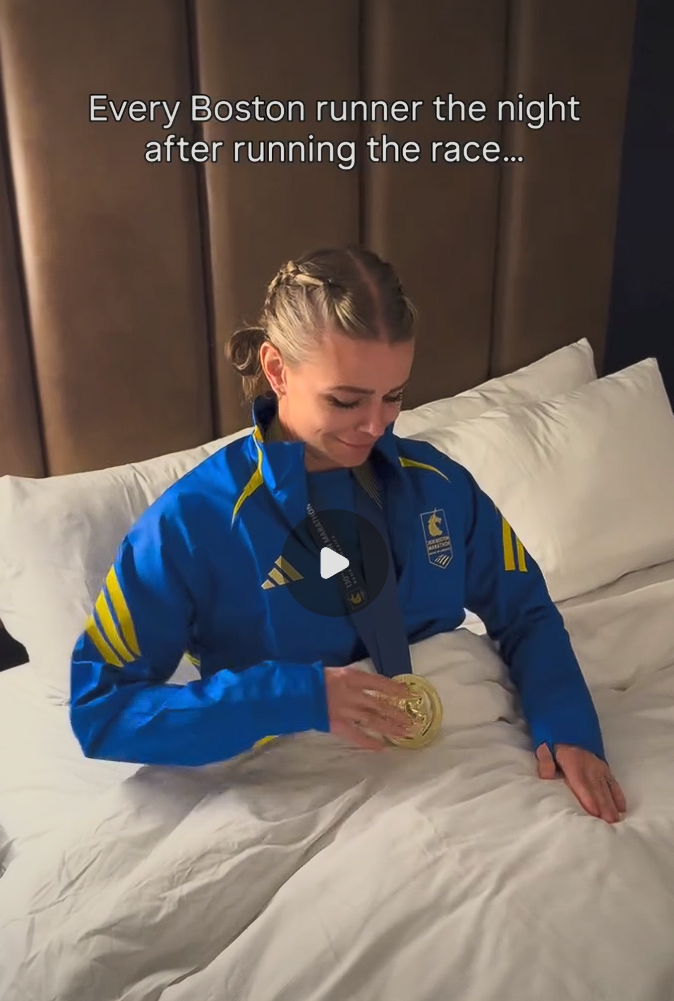
In our experience, walking downstairs the morning after a marathon isn’t much fun. On the other hand, climbing the stairs and heading to bed a few hours after a successful marathon finish is a happy and gratifying reward. @anneliserowe created her own “atta girl” moment in a pretty hilarious fashion Monday night. Check out her style as took her finisher’s medal and coveted Boston jacket to bed with her. Looks pretty cozy to us!